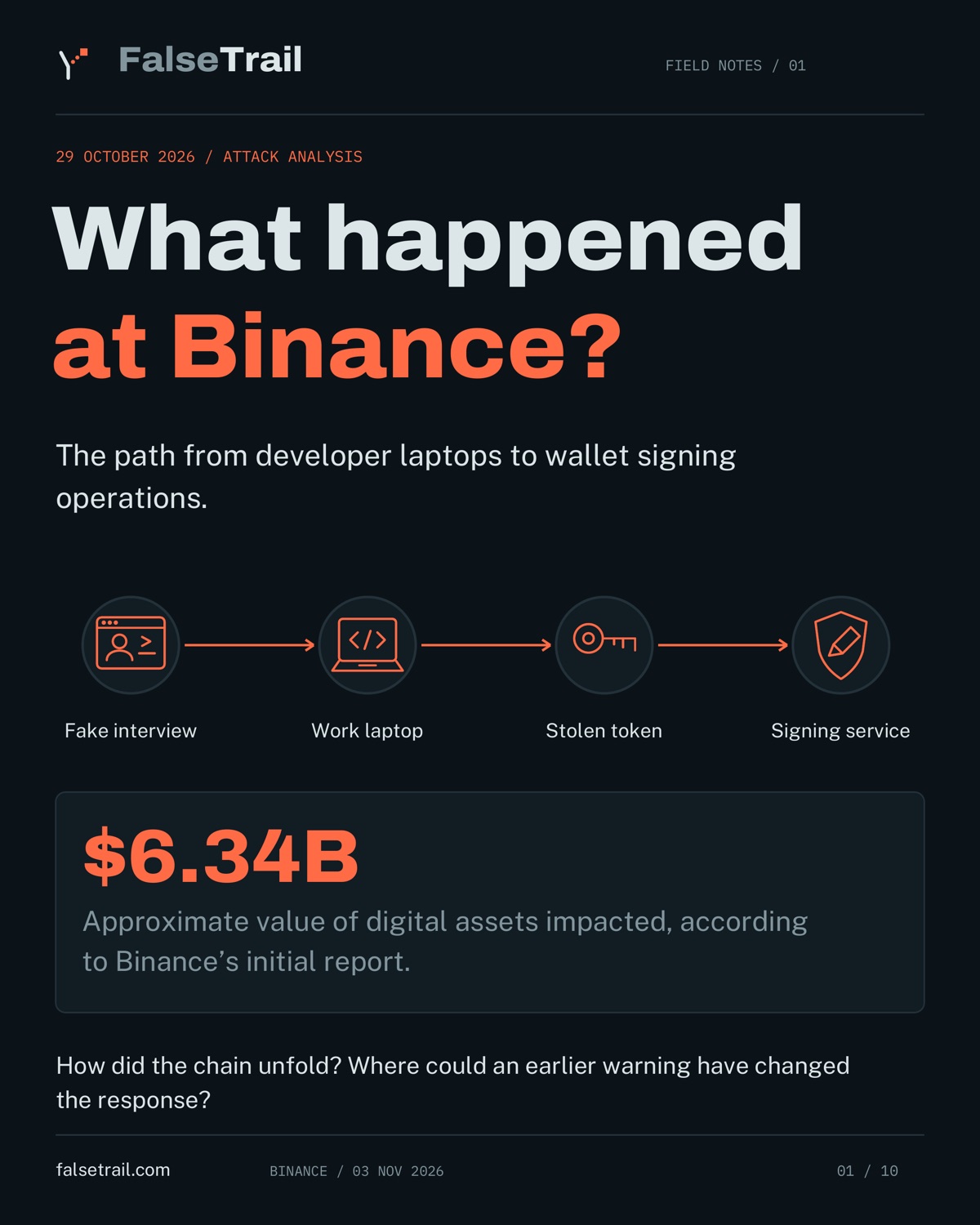
NewIncident brief / 01 · Incident of 29 October 2026 / Attack analysis
What happened at Binance?
The attack chain from a fake interview to wallet signing, what defenders can check at each stage, and where deception fits.
Know the moment someone uses a stolen credential. Legitimate users have no reason to touch these traps, so an alert means something. Then follow every step the attacker takes after it.
AI makes attacks cheap to automate. A well-placed false trail gets found sooner, and when it does, your team needs more than an alert: what happened next, and what is proven.
Enumeration and credential testing cost almost nothing now. Every host and every file gets looked at.
A key found in a config is a key used. One planted value, unique to its place, is all it takes.
No weeks of tuning. The first use of a planted credential is a finding.
Nobody warns automation that db-replica-02 isn’t real. The synthetic path holds, and records every step.
Human or AI, it doesn’t matter.Nobody legitimate uses what you planted. FalseTrail catches whoever, or whatever, follows it, the same way.
The attack chain from a fake interview to wallet signing, what defenders can check at each stage, and where deception fits.
More than a canary. Less than a deception environment to run.
False credentials, unique to where they sit.
Your own tooling puts them in place. Each one learns what legitimately touches it before it arms.
In the productPlacement Fabric
First use, instant finding.
No dead end. Synthetic services answer like the real thing and hand out credentials that only work there, so every next step is observed.
In the productDeception Runtime
Linked by proof, not guesswork.
Steps that use material FalseTrail issued join the finding. Everything else is context, never the path.
In the productOperations · Findings
Every trap is unique to where it sits and believable to the people who work there. Your own tooling, or your MDM, puts it in place.
From a planted cluster token to a privileged synthetic action, each step is joined to the finding by something FalseTrail issued. Refused attempts are kept, and labelled as attempts.
A finding is only as good as what it proves. FalseTrail draws a step into the path only when the evidence supports it.
Every finding names its placement. The first interaction that proves use of a planted opportunity opens the finding.
A step joins only when it uses a credential, token or reference FalseTrail issued. That material is the link, shown on the finding.
Same address, same session: useful, not proof. Shown beside the path, never drawn into it.
What was taken and what was attempted, on record. No guesses about intent or identity.
Issued material seen from a new source links the findings. It never claims the same actor.
Testers and known automation apply going forward. Existing findings are never rewritten.
Synthetic services answer like the real thing and hand out material for the next step. The actor keeps moving, on a path you control.
A real MCP server that AI clients connect to. Its tools answer from the synthetic world.
A Kubernetes API with read-only access to one namespace. Writes are refused, and recorded as attempts.
Trades a client secret for an admin token that only works here.
The decision point: five privileged opportunities side by side. What the actor takes is performed, in the synthetic world.
Bounded: one synthetic world from a versioned template, holding no real data.Reachable only through what you planted; never in your production path.The Cluster API is optional, chosen at install.Finance and HR documents lead to their own business portal: one sign-in, then the trail ends.
See the platform →Built-in integrations for the SIEM and SOAR your SOC runs. Decoys for AWS, Kubernetes, CI pipelines and MCP clients.
Customer-hosted today. Your placements, your evidence and your environment’s context never leave your network. No telemetry, and never a connection back to us.
Your own tooling places the files, or your MDM runs a script that exits. FalseTrail needs access to its own host, nothing else.
No telemetry, no phone-home. Raw evidence stays on your host; only the findings you forward leave it.
FalseTrail is not a proxy. The only way in is something you planted.
Your EDR, XDR and SOAR keep that authority.
FalseTrail is deception your SOC can investigate. It plants believable false opportunities, such as credentials and service references, each unique to where it was placed. The first interaction with one creates a finding immediately. What follows stays inside bounded synthetic services and is linked to that finding through the credentials and references FalseTrail issued, so your team gets an evidence trail rather than a single event.
Today FalseTrail is a customer-hosted deployment: the control plane, decoy services and evidence run inside your environment, on-prem, in private cloud or across a hybrid estate. Sensitive evidence stays local, and you choose what is forwarded to your SIEM.
It starts from the same idea: something planted that nobody legitimate should use. FalseTrail adds a managed placement lifecycle, bounded synthetic services for the actor to continue into, and an evidence model that links later steps only through material FalseTrail issued, keeping correlated activity separate as context.
No. For servers and CI, FalseTrail produces a bundle for each placement, and your own tooling puts it in place and records a receipt: Ansible, Group Policy, Kubernetes or your infrastructure-as-code. For workstations, your MDM (Jamf Pro or Intune) runs one script per group on its usual schedule. Each run checks in, installs or removes that device’s own files and exits. Nothing stays resident.
Yes, finance and HR to start with. FalseTrail plants a genuine Word or Excel document, a payment-run procedure or a payroll calendar in your organization’s name, holding a sign-in and a link for a synthetic business portal. Opening it in Word, Excel or LibreOffice is recorded, and using its password or link opens a finding that names the workstation.
A finding opens only when an interaction proves use of something you planted, so a scanner reaching a decoy port proves nothing on its own. Placements start in Learning, where FalseTrail identifies legitimate automation and authorized testers and records them as narrow, expiring patterns. Interactions it cannot explain still alert.
FalseTrail doesn’t classify attackers as human or AI, and doesn’t need to. An opportunity you planted has no legitimate user, so whoever or whatever uses it is detected the same way. Automation tends to find planted opportunities sooner because it looks at more of the environment.
Not necessarily, and FalseTrail doesn’t claim it is. When material FalseTrail issued turns up again from another source, the findings are linked by that material, so your team can see the connection and decide what it means.
Once a planted opportunity is used, bounded synthetic services answer convincingly, so the actor’s next steps land on synthetic assets and are recorded. It buys your team time and context. FalseTrail does not hack back or act against real systems, and it does not guarantee containment, which stays with your response tools.
No. It feeds them. FalseTrail produces findings with context and leaves correlation, response and containment to the stack you already run.
Evaluate FalseTrail on your own estate. We start with a walkthrough on a sample environment, then scope an evaluation inside your network.