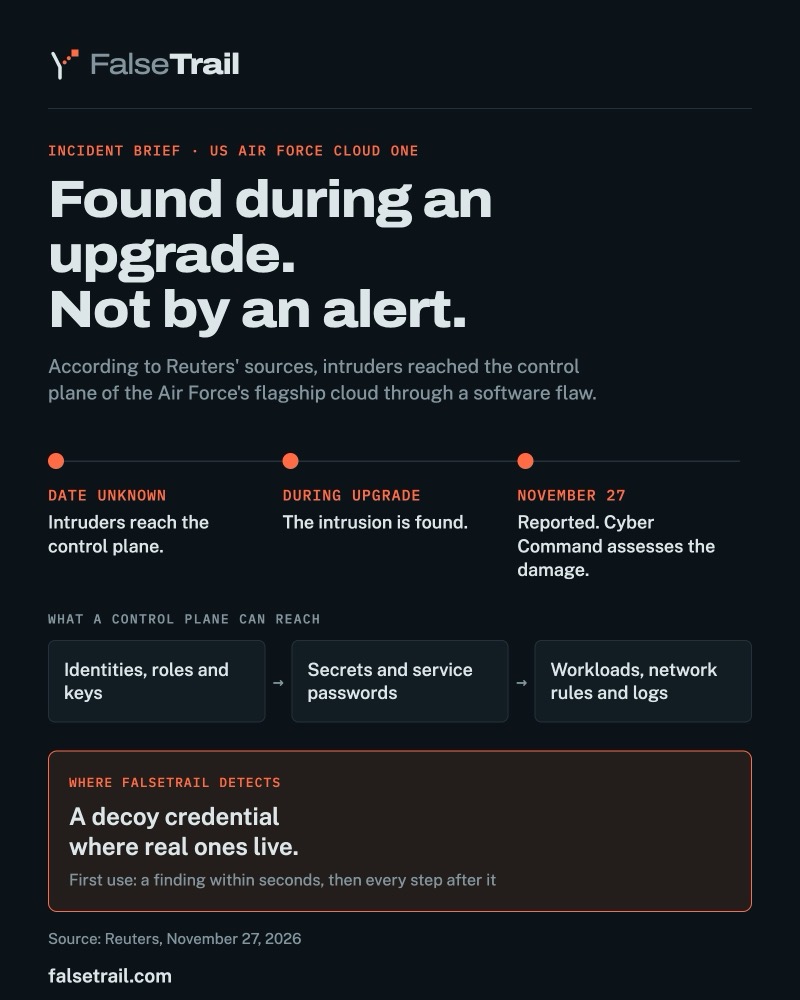
On 27 November 2026 Reuters reported that hackers had breached Cloud One, the US Air Force’s flagship cloud platform. The report rests on anonymous sources, and the Air Force has not confirmed the details. This brief keeps to what was reported and asks one question: once someone is inside a platform this large, how fast does anyone know?
What was reported
- Intruders reach the control plane
One source told Reuters the attackers got to the platform's control plane by taking advantage of a software flaw. Reuters could not identify which one.
- The intrusion is found during upgrade work
Three people familiar with the matter told Reuters the breach was discovered while the system was being upgraded, and that it has disrupted the platform.
- Cyber Command called in, the platform locked down
Investigators brought in US Cyber Command to assess the damage. Updates to applications already running on Cloud One were blocked, leaving teams unable to install fixes as a new batch of serious vulnerabilities was disclosed. A fifth source said some users had their administrator rights revoked, and migration of back-office applications to the platform was reportedly paused.
- Reported by Reuters
The Air Force said it does not comment on the security posture or status of specific systems, and that it continuously takes measures to protect its information. Leidos referred questions to the Air Force.
What Cloud One is, and what it isn’t
Cloud One started in 2017 as a one-stop shop for the Air Force’s IT. Instead of each program buying its own hosting, applications move onto one shared platform that combines four commercial clouds: Microsoft Azure, Amazon Web Services, Oracle Cloud and Google Cloud. Air Force material describes it as the hosting layer underneath everything else, including Platform One, the Department of Defense’s software factory, which runs on top of it. It carries work from public, non-critical data up to classified: an Air Force program article mentions one application already running at the secret level (Impact Level 6) and more in the pipeline.
It is not a weapons system, and it is not the whole Air Force network. It is the shared ground that many systems stand on. That is what makes a breach of its control plane different from a breach of one application: one foothold can sit under many tenants at once.
What may have been affected
Reuters’ sources say the breach could put a large amount of sensitive tactical, personnel and logistics data at risk. The applications reported to run on Cloud One give a sense of the range:
Being hosted on the platform is not the same as being accessed. Reuters could not establish whether any data was taken, and none of the sources say which applications the intruders reached. What a control plane makes possible, in general, is broader than any one application: the credentials that tenants store there (database passwords, service accounts, keys to systems outside the cloud) are the kind of thing an intruder collects first. If any of those lead to on-base systems or to contractors, the exposure would extend beyond Cloud One. That is speculation, and it is the reason investigators usually rotate every credential a compromised platform could read.
Why “found during an upgrade” matters
A software flaw in a large platform is not the surprising part. Every platform of that size will have one at some point, and Cloud One’s own leadership wrote in 2023 of a “100% success rate” against attempts to break in. Prevention can be very good for a long time and still fail once.
The part worth studying is how the intrusion surfaced. According to the sources, it was not an alert. It was work on the system for another reason. When discovery depends on someone happening to look, the intruder sets the timeline: how long they stay, what they read, and what they leave behind.
A control plane is also the worst place for that gap. Whoever holds it can usually create identities, read secrets and change what runs, and much of that looks like administration.
What a control plane is
A cloud platform has two layers. The data plane is where the work happens: the applications, their databases, the traffic between them. The control plane is the layer that manages all of that. It starts and stops workloads, issues identities and keys, stores secrets, sets network rules, ships new code and collects the logs.
In Kubernetes it is the API server and the cluster store behind it. In a public cloud it is the management API and its identity service. In a shared platform like Cloud One, which hosts many applications for many teams, it usually also includes the deploy pipelines and the tooling that onboards each new tenant. Reuters’ reporting does not describe Cloud One’s architecture; this is how platforms of this kind are generally built.
What reaching a control plane can mean (general, not specific to Cloud One)
- A flaw in a management API or portalDecoy: an admin API key in its config
- An administrator's sign-in or tokenDecoy: a cloud access key on an admin laptop
- A contractor's or vendor's accessDecoy: an SSH key on their jump host
- Keys on a build runnerDecoy: a kubeconfig beside the real ones
- A workload that breaks out of its boxDecoy: a service account token in the cluster
- Identities: new accounts, roles and keysDecoy: an access key no one uses
- Secrets: database and service passwordsDecoy: an entry in the secrets store
- Workloads: what runs, and with which codeDecoy: a deploy key and a Git remote
- Network rules: who can talk to whomDecoy: a database URL in an app's config
- Logs and monitoring: what anyone seesFindings kept on FalseTrail's own host
Inside or outside: how someone could get there
We do not know how the intruders reached Cloud One beyond the source’s mention of a software flaw. The two routes below are general and speculative. They are here because each one changes what a defender would see first.
From outside
- An exposed management surface
A portal or API reachable from the internet has a flaw, or accepts a stolen admin session.
- A trusted third party
A contractor's account, a support tool or an update channel already has a path in.
- Control plane reached
The first signal, if any, is at the edge: the identity provider, a web firewall, an unusual sign-in. If it is missed, everything after looks like administration.
From inside
- A foothold in one tenant
One application on the platform is compromised: a vulnerable web app, a poisoned dependency, a phished developer.
- Credentials found nearby
A service account with too many rights, a cluster config on a build runner, a deploy key in a repository.
- Control plane reached
No edge alert fires, because the intruder never crossed the edge again. They use credentials that look legitimate.
Both routes end the same way: an intruder holding real-looking credentials, doing things an administrator could do. On the outside route there is at least a chance of an alert at the edge. On the inside route there may be none. The common step in both is a credential being picked up and used, which is the step a planted decoy is built for.
Four questions for your own platform
- If someone reached our control plane today, what would tell us? Name the alert, not the team.
- Which credentials sit in the control plane (service accounts, deploy keys, cluster tokens, secrets stores) and which of them would anyone notice being used from a new place?
- During an incident, can we still patch? Reuters reports that blocked updates left teams unable to fix new vulnerabilities. Decide in advance how changes are made while a platform is under investigation.
- Can we tell what the intruder did after the first step? If the answer depends on logs that the control plane itself can change, it is weaker than it looks.
Where a planted credential fits
What was reported
- Intruders reach the control plane through a software flaw.
- Time inside is unknown.
- The intrusion surfaces during upgrade work, and Cyber Command assesses the damage.
With decoys planted inside
- Decoy credentials sit where real ones live: cluster configs, deploy keys, a secrets store. No legitimate job uses them.
- An intruder who reads and tries what they find picks one up.
- At its first use a finding opens and reaches the SOC, naming which decoy, planted where, and every step taken on that trail after it.
We are not saying FalseTrail was deployed at Cloud One or would have changed this outcome; how the intruders moved is not public. We are saying that discovery after entry should not wait for the next maintenance window. See how a finding is built, where decoys can be planted and the brief on ARTEX, the FBI’s warning on AI attack agents.
What is still unknown
- Which software flaw was exploited.
- When the intruders first got in, and how long they were inside.
- Whether data was taken, and which.
- Which applications or tenants the intruders reached, and whether Platform One or systems connected to Cloud One were affected.
- Who is responsible.