On 13 November 2026 the FBI published a FLASH about ARTEX, an open-source framework that lets AI agents carry out an intrusion with little human direction. The FLASH is marked TLP:CLEAR, so anyone can read and share it. This brief walks through it with one question in mind: where were the credentials?
In short
- A sentence becomes an intrusion. The operator writes a goal; AI agents scan, exploit, escalate and collect, using rented models such as DeepSeek, Claude and GPT.
- Old techniques, new pace. Nothing in the FBI's list is new. Some intrusions reached privileged access in under three hours, against many targets at once.
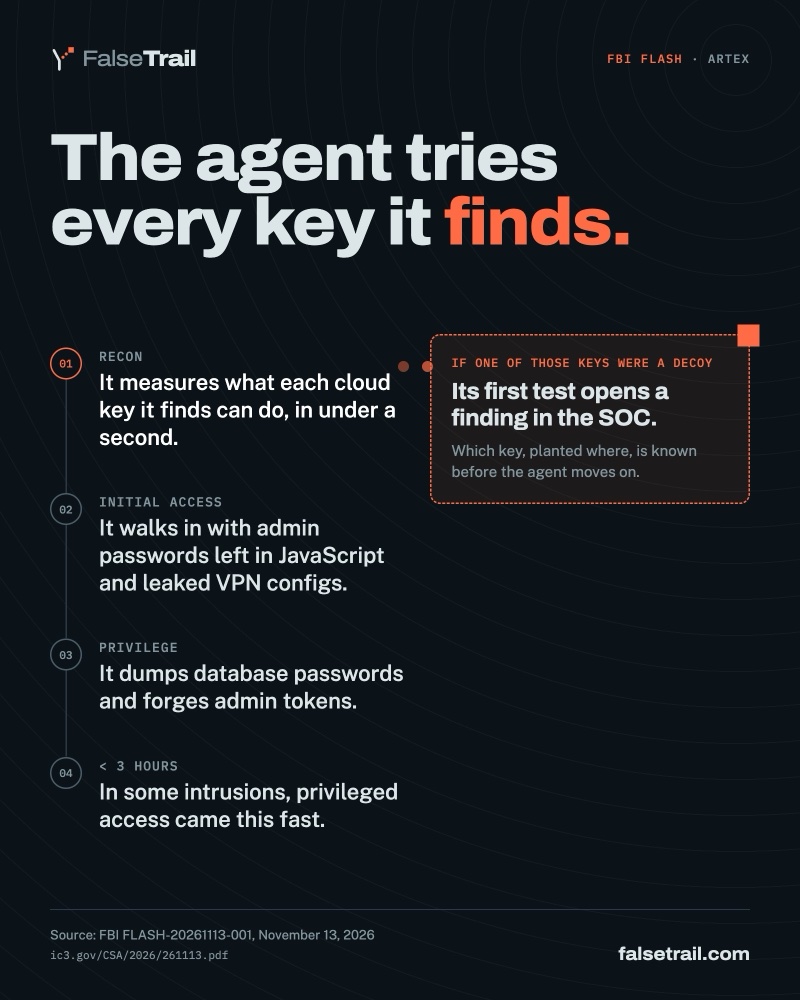
- Credentials run through it. 17 of the 50 activities the FBI lists find, test, forge or steal one, and found cloud keys are tested with sub-second checks.
- That habit is a detection opportunity. An agent that tests every key it finds will test a planted one too.
What is ARTEX?
ARTEX is an autonomous, multi-agent penetration testing platform written in Go. The operator sets an objective in natural language. The framework breaks it into tasks for specialised agents, which the FBI calls “super intelligence (SI) agents”, and they run the commands, against several organisations at once.
Get into these companies and pull their customer records.
Targets, in parallel
- Partner portal
- Mobile backend
- Cloud tenant
- Legacy service
- RERecon
- EXExploit
- FHFoothold
- PEPrivilege
- LMLateral
- COCollect
Rented models
- Claude
- GPT
- DeepSeek most used
- GLM
- Grok
- Kimi
ARTEX has no model of its own. It plugs into external model providers: frontier models such as Anthropic Claude and OpenAI GPT, and open-source or Chinese-origin models such as DeepSeek, GLM, Grok and Kimi. In attacker-controlled instances, the FBI says Chinese models are the most common, with DeepSeek’s Flash models dominant for their cost, capability and lack of observable guardrails when a request is framed as penetration testing.
It was built for authorised testing. The developer, “Autumn-27”, said so and removed the repository once abuse was reported. It did not matter much: the FBI lists forks, localised versions, archived copies and a paid edition, ARTEX PRO.
How it spread, in order
- Released on GitHub
"Autumn-27" publishes ARTEX. It gathers an estimated 1,500 to 2,000 stars within ten weeks.
- Abuse begins
The FBI dates malicious use to at least August.
- South Korean banks
CrowdStrike and Zscaler report a campaign against South Korean financial institutions.
- Repository removed
The developer makes the GitHub repository unavailable. Copies keep circulating.
- A supply chain campaign
Microsoft reports a nation-state campaign using ARTEX against ConnectWise Cloud Backup customers.
- The industry reports
Akamai, Google Threat Intelligence and Mandiant, Censys, CERT-EU and Check Point publish analyses.
- 1,600+ consoles exposed
Researchers find over 1,600 ARTEX consoles reachable from the internet, with more likely behind firewalls.
- FBI FLASH
The FBI publishes FLASH-20261113-001 with techniques, indicators and recommended actions.
Who was targeted
The FBI names ten sectors:
And three campaigns in detail:
For ConnectWise customers the FBI’s advice is specific: review every Microsoft 365 tenant where the affected applications are or ever were authorised, search by application ID rather than display name, look back to at least 1 October 2026, and keep the connections disabled until ConnectWise publishes restoration steps. Preserve evidence before deleting anything.
What the agents did, phase by phase
The heart of the FLASH is a table of observed activity mapped to MITRE ATT&CK. Condensed:
- ReconMap what each found Azure or AWS credential can do, with sub-second checks, test writes and dry runs. Fuzz web paths, scan, look up the victim's location.
- Initial accessUnsigned SAML, XXE, SSRF, SQL and command injection, hardcoded admin passwords in JavaScript bundles, weak admin passwords, stolen VPN configs, leaked credentials, partner trust.
- FootholdWeb shells, open-source RATs, SSH keys, password resets, new credentials added to existing OAuth apps.
- PrivilegeKerberoasting, DCSync for the krbtgt key, database credentials dumped by SQL injection, admin tokens forged with keys nobody rotated.
- InsideOver 110,000 directory objects enumerated, LAPS passwords read, hosts without endpoint protection listed. Pass-the-Hash and Pass-the-Ticket tried.
- CollectionDatabases, mailboxes and storage read in bulk, new 100 GB volumes created to stage data.
None of it is new. The FBI’s point is the pace: agents chain these steps faster than a person can, against many targets at once.
Read it for credentials
We took every activity in the FBI’s table, one tile each, and lit the ones where a credential is found, tested, forged, stolen or added.
- Azure key permissions mapped
- IAM permissions tested with DryRun
- Web paths fuzzed, 500+ requests
- WHOIS mapping, vulnerability scans
- Victim geolocation looked up
- Unsigned SAML assertions
- XXE
- Anonymous file upload
- Cross-account cloud trust
- Vendor credentials over B2B federation
- SSRF
- Admin passwords in JavaScript bundles
- APIs without authentication
- Command injection
- IDOR
- Weak admin credentials
- Template injection
- SQL injection
- Authentication bypass
- Stolen VPN configs, leaked credentials
- JSP and PHP web shells
- Kudu admin API abuse
- C2 on internal database servers
- Open-source RATs
- SSH key pairs created
- Password-reset takeover
- Credentials added to OAuth apps
- Compute launched with high-value roles
- Kerberoasting
- Database credentials dumped via SQLi
- DCSync for the krbtgt key
- Accounts created with is_admin=true
- Delegation abuse
- Metadata service queried via XXE
- Admin token forged with unrotated keys
- Domain controllers enumerated
- 110,000+ directory objects listed
- LAPS passwords read
- Endpoint sensor coverage mapped
- Pass-the-Ticket, Pass-the-Hash, WinRM, Kerberos relay
- Backend databases queried
- Mass storage reads
- Boot scripts on cloud instances
- Output sent to webhook.site
- Mailboxes read
- 100 GB staging volumes
- Residential proxies
- Tor, SOCKS, compromised relays
- Chisel and SoftEther tunnels
- BLOODALCHEMY
The secrets came from everywhere an organisation keeps them: files and front-end code, cloud keys and tokens, partner federation, the directory, and credentials bought or leaked before the attack began. The FBI’s own recommendations land in the same place. Among its immediate actions: review configurations, environment variables, infrastructure-as-code, deployment scripts, CI/CD pipelines and databases for embedded secrets; scan repositories, images and pipelines continuously; rotate exposed credentials promptly; watch for new credentials on applications and for unexpected privilege assignments.
Every key gets tried, fast
One detail in the FLASH matters more than it looks. When ARTEX finds a cloud credential, it does not file it away. It measures it: sub-second capability checks, test blob writes and deletes, ARM deployment dry runs, IAM permission tests with DryRun flags. The FBI asks victims for exactly these traces.
- reconread deploy/.env on ci-runner-072 keys found
- key 1capability check< 1 s · valid
- key 1test write, then deleteok
- key 1permission test with DryRunmapped
- key 2capability check< 1 s
- FINDING · first use of a decoy key · planted in ci-runner-07: deploy/.env · sent to the SOC
That is the behaviour of an agent with no reason to be selective. Testing a key costs it nothing, so every key it finds gets tested, soon after it is found. A person might skip an odd-looking file. A goal-driven agent working down a list usually won’t.
The FBI also describes the other side of that haste. ARTEX is forensically noisy: bursts of activity, failed attempts with small iterative changes, sub-agents overwriting each other or sending duplicate requests. It is noisy but quick. In the FBI’s words, attack speed leaves “limited time for coordinated defender response before objective completion.” Noise that needs a day of correlation arrives too late against an intrusion that finishes in three hours.
How an agent shows up in your logs
The FLASH lists what to look for and what to send the FBI. Condensed into one table:
| Signal | Where to look |
|---|---|
| Outbound calls to model APIs (api.anthropic.com, api.deepseek.com, open.bigmodel.cn, api.x.ai) alongside other suspicious activity | Proxy and egress logs |
| Self-hosted LLM gateways or reseller software (CLIProxyAPI, New API); token use or API billing anomalies | Egress logs, provider billing |
| High-frequency, sequential requests against login and search endpoints; many records read per session on portals | Web, WAF and application logs |
| Test blob writes and deletes with sub-second timing; ARM deployment dry runs across many resource types | Azure activity and storage logs |
| Unexpected IAM role assumptions, PassRole calls, new SSH keys, Elastic IPs, VM launches | AWS CloudTrail, Azure activity log |
| Credentials added to OAuth apps, new service principals or owners, consent grants | Entra ID audit log |
| Compressed bursts; failed attempts with small changes each time; duplicate requests from sub-agents | Any of the above |
| *.aspx or *.jsp files in unexpected web paths | Web servers |
| Names, phone numbers or financial data leaving over HTTPS | Egress, DLP |
No single row proves an agent. Several together, inside a short window, describe a machine working fast.
AI agents on both sides of the attack path
ARTEX is one tool. The pattern it shows is wider, and AI agents now appear in three places in an attack.
Put together: an attacker’s agent, paid for with someone’s model key, looking for credentials in the places your own agents keep them. The guides on AI-driven attacks and securing AI coding agents go further into each.
What defenders can check this week
- Peripheral systems. List every internet-facing app, including partner portals, mobile backends, sales tools, legacy services and integrations built by other business units. The FBI puts this first.
- Secrets in code you ship. Search built JavaScript bundles, not only repositories, for passwords and keys. The FLASH names hardcoded admin passwords in front-end bundles.
- Admin and publishing endpoints. Put cloud admin, Kudu/SCM, backup and hypervisor interfaces behind trusted networks. Turn off basic publishing authentication where it is not needed.
- Application credentials. Alert on credentials added to existing OAuth apps and service principals, and review their sign-ins, successful and failed, separately.
- Keys nobody rotates. Signing keys and long-lived tokens were used to forge admin access. Know which ones exist and when each was last changed.
- Error pages. Stop returning stack traces, SQL errors and internal paths to unauthenticated users. An agent reads every one.
- Rate limits on business APIs. Limits, thresholds and alerts on portals and APIs that return customer records, so a sequential sweep is slowed and seen.
- Model API traffic. Note which hosts may call model APIs. An unexpected call to a model provider or an LLM gateway from a server is worth a look.
- Speed of first signal. Ask how long your current alerts take to fire on a three-hour intrusion, end to end.
Where a planted credential fits
What the FLASH describes
- The agent finds credentials in files, bundles, CI variables and cloud stores.
- It tests each one within seconds and maps what it can do.
- Defenders get noisy activity and little time to sort it.
With decoys among them
- Decoy credentials sit where real ones live: a deploy .env, a kubeconfig, a CI secret, an AWS key, an MCP config.
- No legitimate process uses them. The agent finds one and tests it like the rest.
- That first use opens a finding and reaches the SOC, naming the decoy, where it was planted, and what followed on that trail.
The FBI’s table names 43 ATT&CK techniques. Seven of them already have decoy patterns in our free ATT&CK to deception mapping:
- T1595
- T1580
- T1087.004
- T1069.003
- T1526
- T1190
- T1078
- T1133
- T1195
- T1199
- T1606.002
- T1552.001
- T1505.003
- T1078.004
- T1098.001
- T1574.001
- T1036.005
- T1105
- T1059
- T1134.001
- T1098.003
- T1552.005
- T1606
- T1558.003
- T1518.001
- T1555
- T1087.002
- T1552.006
- T1059.001
- T1550.003
- T1550.002
- T1021.006
- T1557.001
- T1114.002
- T1555.006
- T1530
- T1005
- T1074.001
- T1074.002
- T1090
- T1090.003
- T1572
- T1071.001
We are not saying FalseTrail would have prevented any of these intrusions. We are saying an agent that tests every key it finds will test yours too, and a decoy turns that test into a finding at the first use. See the integrations, how a finding is built and the guide on detecting AI agents with decoy credentials. Related briefs: WorkOS and Fireworks AI.
What is still unknown
- How many organisations were compromised in total; the FBI gives campaign figures, not a sum.
- How many ARTEX deployments exist beyond the 1,600+ consoles visible from the internet.
- Who is behind ARTEX PRO, and how it differs from the open-source version.
- Which actors used which models; the FBI describes prevalence, not a breakdown.