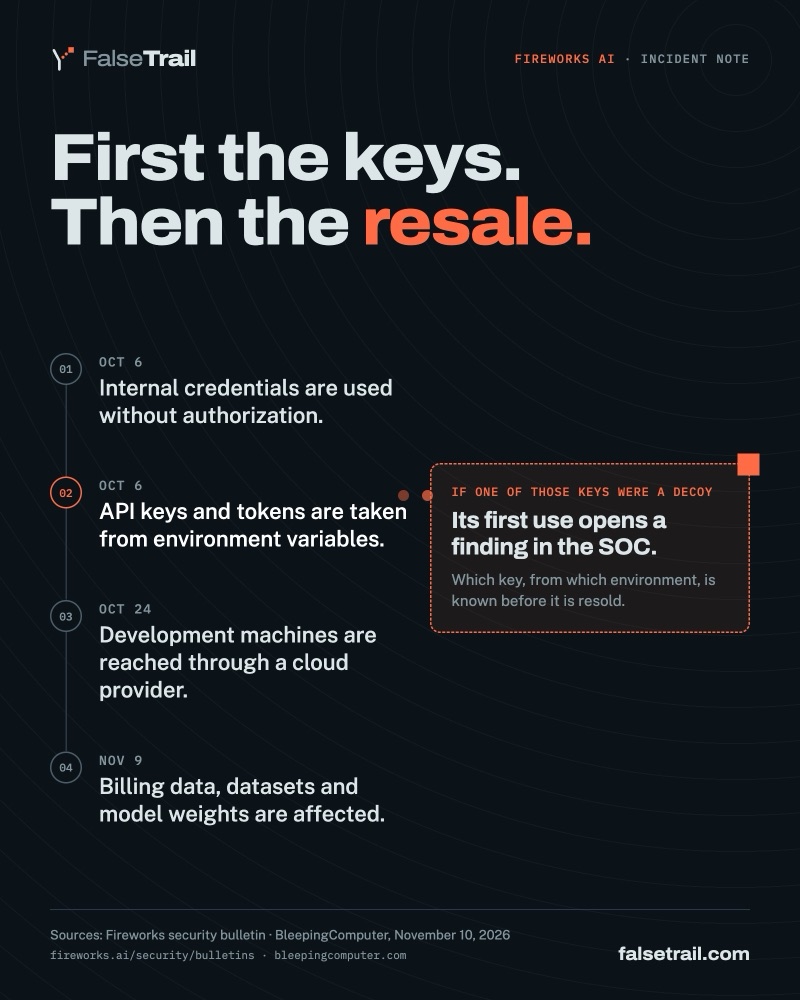
Fireworks AI disclosed two security incidents within a few weeks. Both times, the attacker was after the same thing: credentials. Below is what Fireworks and BleepingComputer report, in order, with what defenders can take from it and where a planted credential fits.
What happened, day by day
- Internal credentials misused
Fireworks identified unauthorized use of internal Fireworks credentials and began containment the same day. An unauthorized third party had accessed environment variables used in evaluation jobs in a limited number of customer accounts, including API keys and tokens stored as secrets.
- Notification and rotation
Fireworks began notifying affected customers on 7 October, rotated employee API keys and published its bulletin on 9 October, and on 10 October revoked further user API keys and rotated service-account tokens found in a credential review.
- A provider is breached
A third-party cloud provider that hosted Fireworks R&D machines had a security incident.
- Development machines reached
The unauthorized third party used that access to reach Fireworks development machines and ran an unauthorized workload. Fireworks detected the activity the same day.
- Platform check
Fireworks said that, as of this date, it had not detected further successful unauthorized access on the platform customers use.
- Second advisory
Fireworks published an advisory on the second incident, reported by BleepingComputer on 10 November.
Two chains, one target
- Internal credentialsFireworks credentials are used without authorization.
- Secrets in job environmentsEnvironment variables of evaluation jobs, holding API keys and tokens, are read.
- A hosting providerThe provider hosting R&D machines is breached on 23 October.
- Development machinesReached on 24 October; an unauthorized workload runs.
- Data impactResource metadata, billing information, incomplete model weights and datasets.
What was affected
For the first incident, Fireworks’ bulletin reported no evidence of access to customer models, datasets, training data, personal information or inference traffic; it notes the platform does not store prompts or outputs by default. The second incident later affected incomplete model weights and datasets for some customers.
Who is behind it
Fireworks links the first incident to a financially motivated cybercriminal group that sells tokens from unauthorized access to LLMs to illicit routing gateways, a pattern known as LLMjacking. The second incident has not been attributed to a group.
Model access is billed per use, so a working API key is directly worth money. That makes the places keys live predictable targets: environment variables, configuration files, CI secrets and cloud secret stores.
What Fireworks did, and asked customers to do
After the first incident, Fireworks revoked the internal credentials used, the affected API keys and keys created by the actor; rotated employee API keys and service-account tokens; added access restrictions; began reviewing how secrets reach evaluation jobs; and engaged a cybersecurity firm. Affected customers were asked to:
- Replace revoked Fireworks API keys they still need.
- Rotate third-party credentials listed in their notice with the issuing providers. As the bulletin puts it, removing a stored secret does not invalidate the credential.
- Review activity tied to those third-party credentials with the providers, and rotate them even without suspicious activity.
- Check for unrecognized API keys, users, evaluators, training jobs and datasets.
After the second incident, Fireworks closed known critical vulnerabilities, revoked and replaced credentials and service accounts, restricted unauthorized network pathways, isolated affected systems, tightened access to data storage and analytics systems, and engaged Palo Alto Networks’ Unit 42.
What defenders can check
- Secrets in job environments. List where customer or internal API keys are injected as environment variables, and who or what can read them.
- Rotation, not deletion. When a secret is exposed, rotate it at the issuer. Deleting the copy you stored changes nothing for the attacker.
- Scope of internal credentials. Internal service credentials should not be able to read customer job environments unless they must.
- Third-party hosting. Know which machines a cloud or hosting provider runs for you and what credentials sit on them; a breach at the provider is a path to you.
- Key usage alerts. Alert on API keys used from new networks or at unusual volume, and on new keys you did not create.
Where a planted credential fits
What happened
- Secrets in job environments are read with misused internal credentials.
- Real keys are taken alongside everything else in those variables.
- Response means revoking and rotating every key that might have been exposed.
With a decoy key among them
- A decoy key sits where real keys live: a deploy .env file, a CI environment, AWS Secrets Manager.
- It is collected with everything else. No legitimate job ever uses it.
- At its first use, a finding opens and reaches the SOC, naming which key, planted where, and what happened next on that trail.
We are not saying FalseTrail was deployed at Fireworks or would have prevented this. We are saying that if one of the stolen keys is yours, you learn the first time it is used. See the integrations for cloud and CI decoys, how a finding is built and the guide on detecting AI agents with decoy credentials. Related brief: What happened at WorkOS?
What is still unknown
- How the internal credentials used in the first incident were obtained.
- Which cloud provider was breached; it is not named.
- How many customers were affected in either incident.
- Whether the two incidents involve the same actor.