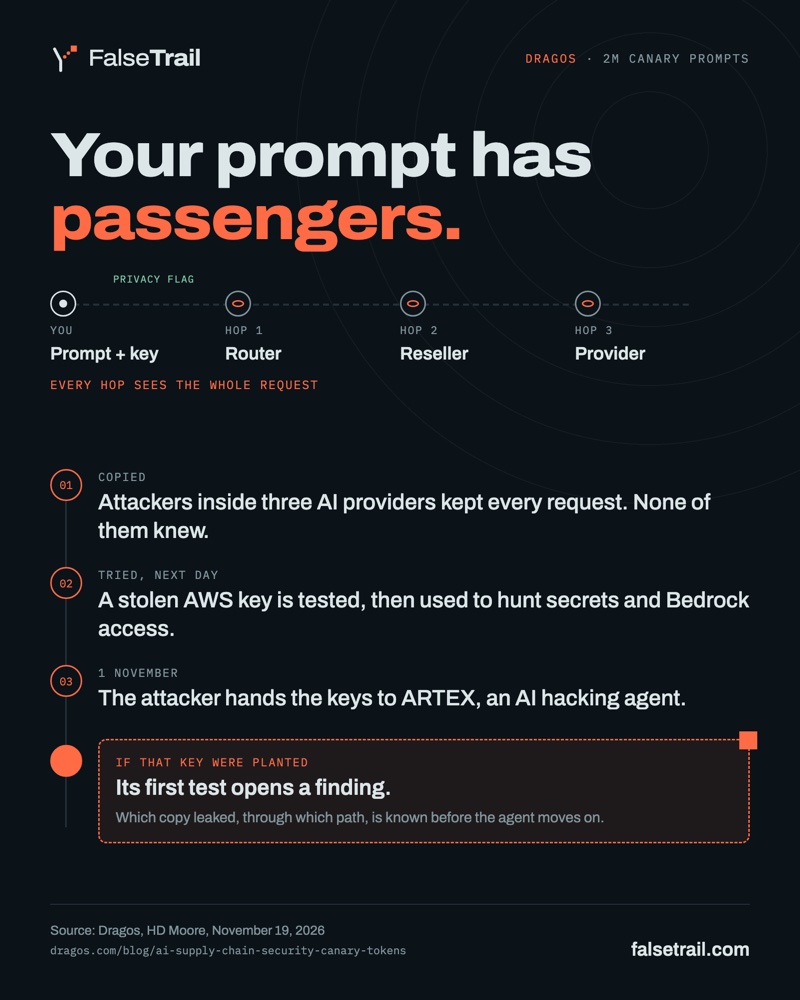
On 19 November 2026 Dragos published research by HD Moore, its Chief Research Officer and the creator of Metasploit. For five months his team hid secrets in prompts sent to AI services and waited to see who would use them. This brief walks through what came back, with the same question as brief 04 on ARTEX: where were the credentials, and who tried them?
In short
- A prompt is a copy you hand out. Between you and the model sit routers, resellers and hosting providers. Each hop can read the whole request.
- Copies were taken. Attackers inside three providers, resellers with logging on, and a lab that ignored privacy flags all held prompts they shouldn't have.
- The keys got tried, by people and by agents. Stolen AWS keys were checked within hours. From 1 November one attacker ran ARTEX against them.
- That habit is the detection opportunity, again. Every copy carried its own key, so every use named the leak. The same works in your own pipelines.
What Dragos did
Each prompt carried secrets that existed nowhere else: a hostname, a URL, a password, and a real AWS key tied to an empty account with full logging. Because every secret was unique, every later use pointed back to one prompt, one model, one router and one privacy setting.
The team also traced routes. An image URL in a prompt reveals every system that fetches it. About 2,000 routes were traced, and several hundred passed through a system Dragos could not identify.
The attack chain, step by step
The largest of the three breaches shows the whole chain. A couple of hundred AWS keys were sent in a few short windows in late October, and every request in those windows was copied. That included requests the provider rejected before any model ran: the copying happened at the provider’s front door.
- Seeded
A unique AWS key goes into a prompt sent to a hosting provider.
- Copied
The provider's intake is compromised. The full request is kept by the attacker.
- First use
The key is checked. Across the study, some keys were tested within hours of being sent.
- Mapped
S3 buckets listed. Secrets Manager and Parameter Store searched.
- Monetised
Attempts to enable Bedrock models and create Bedrock API keys: stolen cloud keys turned into model access.
- Persistence
Attempts to add the attacker's own IAM users.
- ARTEX
After a fake Chrome-on-Windows script, Boto3 and the AWS CLI on Kali, the attacker adds ARTEX. User agents artex-agent and artex-judge-r121 appear.
- Still in use
The same key is still being used. Across the keys, tens of thousands of AWS API calls.
One attacker appeared to be inside two providers at once, working from a single rented server. None of the three providers knew until Dragos told them.
The monetising step is the loop we described in brief 04: a stolen cloud key pays for model access, and model access runs the agent that finds more keys. Here the keys came out of other people’s prompts.
Two more ways prompts leaked
Resellers with logging on. No exploit was needed. A seller on an AI inference marketplace listed the lowest price and turned on request logging. In one case two prompts went through one seller. About a day and a half later, someone on home broadband opened both links and started guessing usernames. The same model through a different seller was never touched.
Privacy settings ignored. A Chinese AI lab fetched the secret links from more than half of the prompts sent to its models, including about two-thirds of the requests marked “no data collection” or Zero Data Retention. Its scraper usually came two to three days later. One link, sent to a US provider with the Zero Data Retention flag on, was posted in a Feishu chat 24 days later. Within two minutes it was opened on three desktops and three phones in Beijing and Shanghai.
On 22 November OpenRouter removed three providers and took Zero Data Retention eligibility away from 125 endpoints, some as a precaution. It says its own systems were not breached.
How it looks with a planted credential
Dragos planted keys in its own prompts to study providers. Most teams have the opposite problem: their prompts, agents and pipelines carry real secrets, and they want to know when a copy is out. Here is the same chain with FalseTrail placements in it. These are illustrations of how FalseTrail behaves, not recorded sessions.
1. A cloud key in a coding agent’s context
A developer’s coding agent reads the project’s deploy/.env and sends parts of it to a model. Among the real values sits a FalseTrail access-key canary: a real AWS key with no permissions, planted in that file and nowhere else. The request is copied at a breached provider’s front door.
- 22 Oct 03:14sts:GetCallerIdentity · decoy key · unknown sourcedenied
- FINDING · first use of a decoy key · planted in payments-api: deploy/.env · read by the coding agent · sent to the SOC
- 03:15s3:ListBuckets · same keydenied
- 03:15secretsmanager:ListSecrets · same keydenied
- 03:16bedrock:PutFoundationModelEntitlementdenied
- 03:16iam:CreateUserdenied
- 1 Novsame key · new user agent: artex-agentadded to the finding
The finding opens at the first call, within minutes, and names the placement, the API, the region and the outcome. Every later call with the key joins the same finding as the actor’s next steps. That key only ever travelled one path: through the agent’s model traffic. So a copy of that file left your environment that way, and you rotate the real secrets in it today, not three weeks later.
2. A login in a prompt template, used by hand
An internal support bot’s prompt template includes a service-account login for an internal admin API. Nobody legitimate uses it; it resolves only to FalseTrail. A reseller in the routing path keeps a log.
What happened
- The template goes out with every request, through a reseller that logs.
- A day and a half later, someone on home broadband tries the login.
- They keep going, looking for more access.
With a placement in the template
- The first sign-in with the planted login opens a finding, naming the template it came from.
- Synthetic services answer, so the next steps land on synthetic assets and are recorded, linked to that finding.
- One placement per route tells you which vendor in your AI path is leaking. Dragos saw exactly this: the leak followed the seller.
3. A link opened weeks later, on six devices
A runbook in an agent’s retrieval index holds an internal link that resolves only to FalseTrail.
- Desktop
- Desktop
- Desktop
- Phone
- Phone
- Phone
The first open is a reference followed, which opens a finding. Each new source that uses material from that trail opens a finding linked to the first, so the six opens arrive together. What you learn: someone kept a full copy of the prompt for weeks and shared it with a group.
What FalseTrail does not do here: it cannot stop a provider from being breached or a reseller from logging. It tells you a copy is out, which copy, and what was tried with it. Rotation and vendor decisions stay with you.
Why AI attackers make this work better
What to check this week
- Keys that ever went into a prompt. Search chat histories, agent logs and prompt templates for secrets. Rotate any you find.
- Your AI path. List every router, reseller and provider your traffic can reach, including fallbacks.
- Router settings that bind. Pin the providers you chose, turn off fallbacks, and ask for Zero Data Retention and no data collection where your router offers them. Then check that the routes actually change.
- Secret filtering. Strip secrets before they reach a model. Dragos calls it helpful but “not a panacea”.
- Your own canaries. Put a planted credential in what your agents and pipelines already send, and treat any use as an incident. That is Dragos’ own recommendation. See detecting AI agents with decoy credentials.
What we’re testing next
We’re running our own smaller version: unique placements in prompts sent through AI routers and providers, with privacy flags on and off, plus placements inside tool outputs and retrieval documents, the agent path this study did not cover. We’ll publish the results, and tell any affected provider before we name anyone.
What is still unknown
- Which three providers were breached, and which lab ignored the privacy flags. Dragos has not named them.
- How many customers’ real secrets were in the copied requests.
- Whether OpenRouter’s 125 endpoints include the three breached providers.
Related briefs: ARTEX, Fireworks AI and WorkOS.